


Folded, half-open long-sleeved top (indigo dyed) Organic Cotton & Recycle
Folded, half-open long-sleeved top (indigo dyed) Organic Cotton & Recycle
Slowly and methodically, like origami, it folds into different shapes, and the huge sheet of paper can always be transformed, as if it has been given new life. The pleated,...
5 In stock
Couldn't load pickup availability


Description
Slowly and methodically, like origami, it folds into different shapes, and the huge sheet of paper can always be transformed, as if it has been given new life.
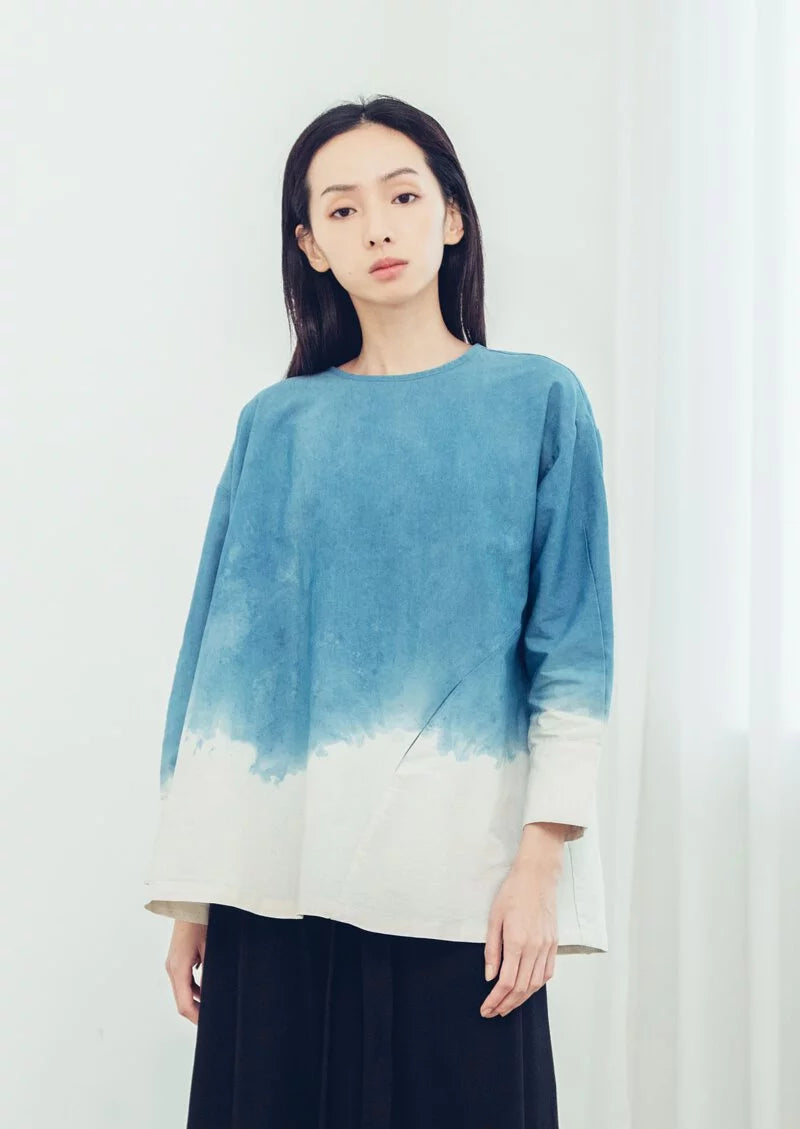
The pleated, half-open long-sleeved top features an umbrella-shaped cut. What's special is the loose fit of the garment and the hidden fastening rings and buttons in the pockets.
It can create a beautiful line by diagonally pleating, which not only makes the top fit better, but also adds more layers and style to the garment.
The design of the slanted half-front placket at the back echoes the slanted pleats at the front, and there is an additional pocket on the side, making it both practical and suitable for your daily wear.
We often hear the saying "the student surpasses the teacher," and we all know it's a metaphor for a student exceeding their teacher.
While later generations may surpass their predecessors, few people know that the original meaning of this phrase comes from Indigo dyeing.
"Blue" refers to a shade of blue called indigo, and "blue" refers to a type of plant used as a dye—the indigo plant.
Therefore, the original meaning of this sentence is that indigo is extracted from the indigo plant. When people first discovered this plant-based blue color,
Everyone thinks this is the most beautiful blue in the world!

This natural dye is made using indigo and a unique fermentation and cultivation technique.
Unlike other natural dyeing plants that use heating to extract plant pigments for dyeing fabric, this method is called "indigo dyeing".

There are roughly four main species of indigo plants in the world: Polygonum tinctorium (Polygonaceae family), Isatis tinctoria (Brassicaceae family), Indigofera tinctoria (Fabaceae family), and Strobilanthes cusia (Acanthaceae family).
The roots and rhizomes of these plants can be used as the traditional Chinese medicine Banlangen, and are also a source of materials for the traditional Chinese medicine Qingdai.
Taiwan's humid climate is ideal for growing indigo plants in the mountains, so indigo dyeing has always been a popular and accessible dyeing culture in Taiwan, preserved and developed to this day.
Before the widespread use of chemical dyes, people extracted pigments and dyes from nature (plants or minerals) and used them in their daily lives.
Indigo dyeing is a technique and culture that represents the best natural dyeing process for skin and land.